The Exhibition Label Before the Wall Text
Exhibition label writing turns limited space into a clear interpretive choice: learn to identify the object, select useful context, and invite a closer look.
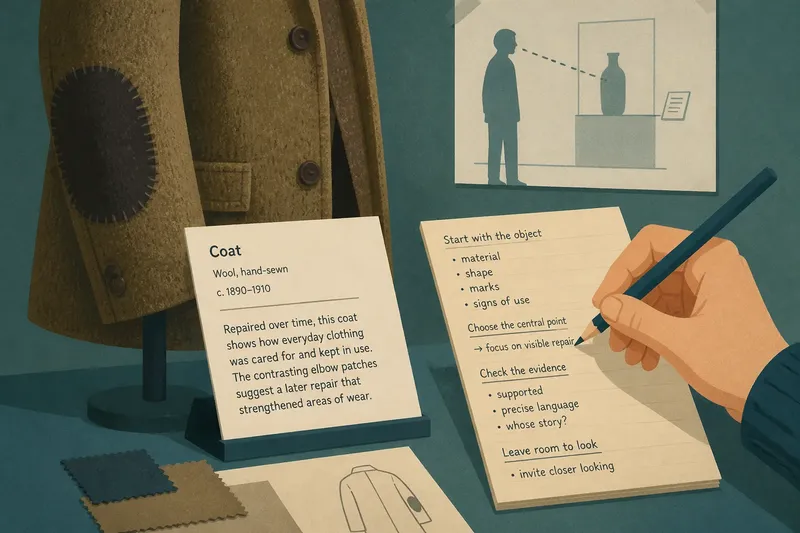
Exhibition label writing begins with a decision about what a visitor should notice, not with a miniature biography of the object. A label has little room, so its words must identify what is in front of you and make a deliberate interpretive choice. That compact form developed alongside museum display as a way to connect an object with a visitor without requiring a longer wall text.
Start With The Object
Stand where a visitor is likely to stand and write down what is plainly visible: material, shape, marks, and signs of use. Separate those observations from what you already know or suspect. A darkened edge may be visible; the reason it darkened may require evidence that the object itself cannot provide.
Then establish the basic identification. Depending on the collection, that might include the maker, title or object type, place, date, material, or the person who used it. These details orient the visitor, but they are not all equally useful for every object. Follow the museum’s cataloging conventions, and avoid turning uncertain attribution into a confident claim.
Think of this first pass as the label’s factual floor: a visitor should be able to tell what they are looking at before being asked to interpret it.
Choose The Central Point
Next, decide what the label can explain that the object alone may not. A tool might make an unfamiliar task visible; a decorated vessel might reveal who it was made to serve; a poster might show how image and wording worked together. Choose one interpretive point that helps a visitor see or understand something specific.
Say you are writing about a hand-sewn coat whose elbow patches differ from the original fabric. You could use the label to explain the owner’s biography, the garment’s construction, or its later repair. If the collection record supports it, focusing on the visible patches could lead visitors to notice how repair changed the coat rather than treating wear as mere damage.
That is a selection, not a claim that the patches tell the whole story. A compact label becomes more useful when it makes its boundary clear instead of squeezing several competing themes into one paragraph.
Fit The Space
Draft the label in a plain text document before fitting it to the display. Start with a clear opening, add the chosen context, then remove anything that repeats the object identification or wanders into a second theme. Read it aloud: a visitor should not have to hold a long chain of clauses in mind while looking back and forth between the words and the object.
Keep specialist terms only when they give the visitor a useful distinction. If a term is necessary, explain it in ordinary language nearby. Prefer a concrete verb such as “stitched,” “cast,” or “traded” over a vague phrase such as “was associated with.”
Space is not just a word-count problem. A label may be placed beside several objects, at a child’s eye level, or where glare makes small type hard to read. Coordinate wording and placement with the exhibition team; an interpretive sentence cannot do its job if visitors cannot comfortably find or read it.
Check The Evidence
Review each sentence for the kind of claim it makes. Identification should match the collection record; claims about use, ownership, or meaning need support; interpretation should be recognizable as an interpretation rather than disguised as settled fact. If the evidence leaves a question open, choose careful wording or leave the claim out.
Also ask whose knowledge the label treats as authoritative. A museum may have a familiar description for an object that overlooks the people who made, used, or cared for it. Where relevant and supported, name those people or communities rather than reducing them to a broad category. Consultation can change not only the wording but also what the label chooses to explain.
A short label cannot contain every perspective. It can, however, avoid implying that the museum’s chosen account is the only possible one.
Read It In Place
Before approval, read the draft beside the object or a full-scale display mock-up. Check whether the first sentence helps orient the visitor, whether the next idea directs attention usefully, and whether the text competes with nearby labels. Ask someone unfamiliar with the object what they understand after reading it; listen for confusion rather than prompting them toward the intended answer.
Make revisions that improve clarity or correct an unsupported implication. Do not keep a sentence merely because it sounds elegant if it asks the visitor to accept more than the evidence supports. For material details, attribution, and terminology, follow the relevant collection record and institutional guidance.
What Should A Label Include?
How Is A Label Different From Wall Text?
An exhibition label usually connects a particular object to a concise piece of identification or interpretation. Wall text addresses a larger theme or group, so it can establish context that would overwhelm an individual label.
Which Object Details Belong On It?
Include details that help identify the object or support the interpretive point, such as material, maker, date, or use. Leave out catalog information that adds no useful meaning for the visitor in that location.
How Can Uncertainty Be Made Clear?
Use precise language that reflects the evidence, such as “attributed to” when authorship is uncertain. If the uncertainty matters to the object’s interpretation, state it plainly rather than hiding it in specialist wording.
How Do You Know When The Draft Is Finished?
The draft is ready for review when a visitor can identify the object, follow one supported interpretive point, and return their attention to the display. If a sentence needs another sentence to explain why it belongs, reconsider the sentence or the point.
Leave Room To Look
The best exhibition label does not try to replace the object with a small essay. It supplies a useful frame, then leaves space for the visitor to notice details the writer did not name. In the next draft, return to the object and ask what the words help someone see that they might otherwise pass by.